How an engagement score should cool off over time
An engagement score should fall when nothing happens. Build it from actions a person chooses to take (clicks, replies, purchases), then discount it by how long ago they last did any of them. Email Digit’s score halves the weight of a contact’s activity for every 30 days since their last click, reply or conversion, and opens add nothing.
The problem with scores that only go up
A score kept as a running total, where every action adds points and nothing takes them away, ages badly. A contact who clicked a dozen links in April and has ignored you since is still “hot” in October, and still at the top of the segment you send your offer to.
That breaks the two jobs a score exists for. It cannot tell you who is engaged now, and it cannot tell you who has drifted away, which is the list you most need before a re-engagement campaign or a clean-up. A score has to cool on its own, without anyone running a manual reset.
Three design choices that make a score honest
- Count only deliberate actions. Opens are recorded by mail apps and security scanners that load images automatically, so they say little about a person. Clicks, replies and purchases need a human decision.
- Weight them by effort. Writing a reply takes more than clicking a link; buying takes more than either.
- Let time erode them. A half-life is the simplest way: after a fixed period with no activity, the activity counts for half as much.
How Email Digit’s score works
The score runs from 0 to 100 and is built in three steps:
- Points. A click is worth 3, a reply 8 and a conversion 15. A click counts once per email, however many links in it are clicked. Opens are worth nothing. Clicks that look machine-generated, such as a security gateway following every link, are recorded but not counted.
- Recency. The total is halved for every 30 days since the contact last clicked, replied or converted. Any new action restarts that clock.
- A curve that flattens. The result is mapped onto 0 to 100 so the first few actions move the score a lot and later ones less. Someone who clicks every link in every email cannot reach 100 on clicks alone.
Here is one contact with one reply and two clicks, and no activity after that:
| Days since last action | Score | Tier |
|---|---|---|
| 0 | 43 | Warm |
| 30 | 24 | Cold |
| 60 | 13 | Cold |
| 90 | 7 | Cold |
| 180 | 1 | Cold |
And the curve at work on clicks alone (one click each in 3, 10, 20 or 40 emails): 3 clicks score 30, 10 clicks 70, 20 clicks 91, 40 clicks 99. Each extra click adds less than the one before.
Tiers and the working shown
| Score | Tier |
|---|---|
| 0 | Dormant |
| 1 to 24 | Cold |
| 25 to 49 | Warm |
| 50 to 74 | Engaged |
| 75 to 100 | Hot |
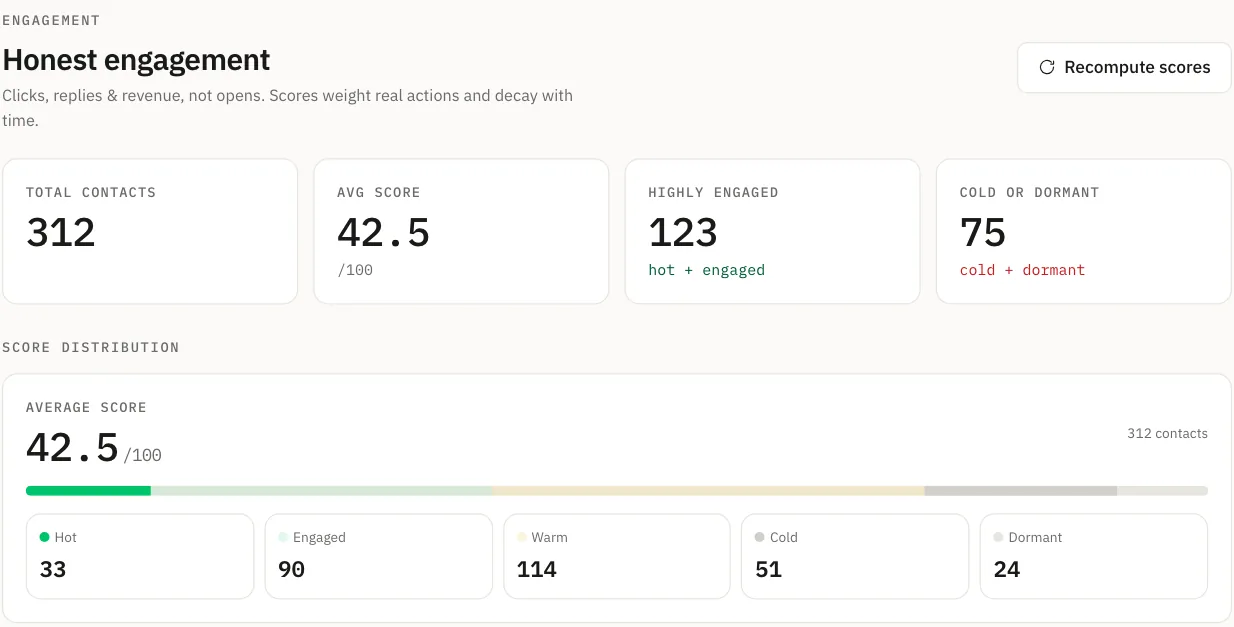
Each contact page shows where the score came from: how many points came from replies, clicks and conversions, adding up exactly to the score. For the contact above on the day of their last action, that is 25 from the reply and 18 from the two clicks. When clicks have stopped adding much, the page says they are “saturating”, and it notes that machine clicks are excluded.
Putting a cooling score to work
- Aim offers at engaged and hot contacts. Because the score falls on its own, an audience picked by score reflects who is engaged now, without anyone rebuilding it.
- Watch the slide from warm to cold. A contact who drops a tier after 30 quiet days is the right audience for a light check-in, before they reach dormant.
- Read the breakdown before you act on one person. A score built from one purchase and a score built from twenty clicks can be similar numbers that mean different things. The first is a customer; the second may be a curious reader who has never bought.
Details and limits
- Decay is by the last action, not per action. The recency discount applies to the contact’s whole history, measured from their most recent click, reply or conversion. A contact who replies today brings their older activity back to full weight too. That keeps the score a measure of the relationship now, not an archive of every past event.
- Repeat buyers keep a floor. A contact with two or more conversions never drops below 15, so a once-a-year customer is not treated like a dead address.
- It refreshes in the background. A contact’s score is updated straight after a click or a conversion, and every score is recalculated on a regular background pass, which is what lets a score cool when nothing is happening.
- The formula is fixed. The weights and the 30-day half-life are the same for every workspace, so scores mean the same thing everywhere in the product.
To act on the contacts whose scores have cooled to nothing, read Stop paying for contacts who never engage.