Sunset list: win back or suppress silent contacts
When a contact has had several emails and has not clicked, replied or bought in months, you have two sensible options: ask once whether they still want to hear from you, or stop sending them marketing. Email Digit’s sunset list finds those contacts for you, and each option is one action from the list. Do the win-back first, then suppress whoever stays silent.
Why the silent part of a list costs you
Every list has people who stopped listening long ago: a job change, an abandoned inbox, an interest that ran its course. Emailing them keeps costing you in three ways:
- Sends. Each one uses part of your monthly email volume.
- Complaints. People who forgot signing up are the likeliest to press “report spam”, and complaints weigh heavily with mailbox providers.
- Reputation. Lots of mail nobody touches tells providers your mail is not wanted, which pushes future campaigns toward spam for the people who do want them.
The hard part is deciding who is silent. Open rates cannot tell you, because some mail apps load every image, tracking pixel included, before anyone reads anything. A dead address can look engaged forever.
Who lands on the sunset list
The engagement page builds the list for you. A contact appears on it only when all of these hold:
- They are still subscribed and not already on your do-not-send list.
- They have received at least 3 emails, so silence is a pattern rather than one missed campaign.
- Their engagement score is 10 or under.
- They have not engaged in 90 days.
- They have never bought. Customers are left off on purpose, because a quiet customer is not a dead address.
“Engaged” means clicked, replied or bought. Opens do not count, so a mail app that preloads images cannot keep a dead address looking alive. The contacts you have emailed the most come first, because they are the ones you have spent the most on.
For how the score itself is built, see Stop paying for contacts who never engage.
The two actions
| Effect | Add to Win-back | Suppress for marketing |
|---|---|---|
| What it does | Adds the selected contacts to a list named “Win-back” | Puts their addresses on your do-not-send list at the marketing level |
| Marketing email | Still sent, so you can run one last campaign | Stopped |
| Receipts, password resets and other app email | Still sent | Still sent |
| The contact record | Kept | Kept, and leaves the sunset list |
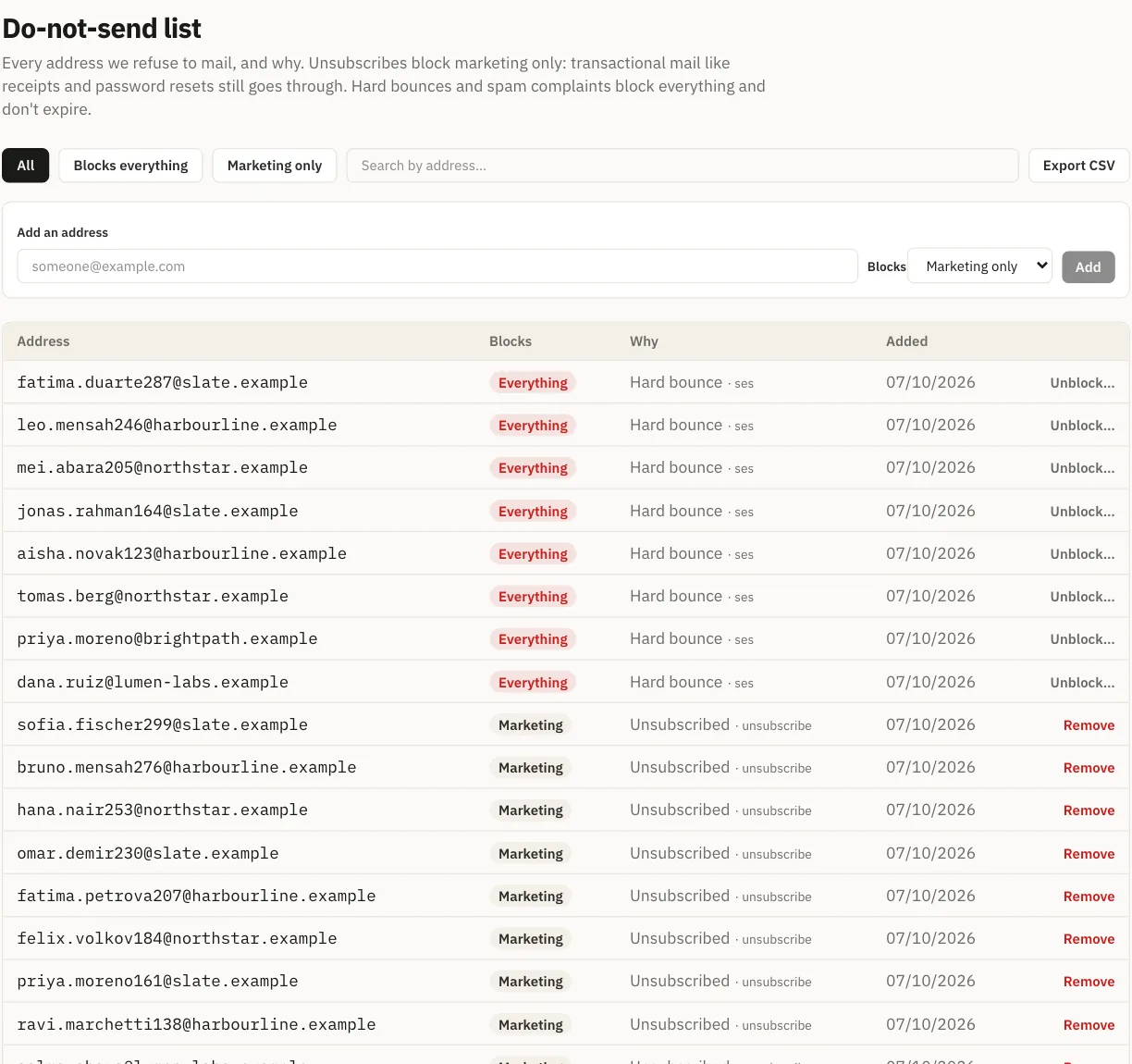
A marketing-level entry is not the permanent kind. Hard bounces and spam complaints put an address on the list for all mail, receipts included. A sunset suppression only stops marketing. Both actions are written to your workspace audit log with who took them, because they shrink the audience you can reach and you should be able to reconstruct why.
Running the win-back
- Select the candidates and add them to Win-back. Running it again on the same people does not add them twice.
- Send one short, plain email to that list. Say why you are writing: they have not heard from you in a while and you do not want to fill their inbox. Ask one question with one clear answer, such as a link that says “Yes, keep me on the list”. Skip the discount unless a discount is what you would send anyway; you want to learn who is listening, not who likes coupons.
- Judge it on clicks and replies. Anyone who clicks or replies raises their score and their last-engaged date, and drops off the sunset list without you doing anything.
- Wait a couple of weeks, then suppress the rest. Reopen the sunset list, select whoever is still there, and suppress them for marketing.
A win-back email can be this short:
Subject: Should we keep writing to you?

Hi,

We haven't heard from you in a while, and we'd rather not fill your
inbox with mail you don't want.

If you'd like to keep hearing from us, click here: Yes, keep me on the list.

If not, there's nothing to do. We'll stop sending you our newsletter.
It asks one question, makes the yes a click, and says plainly what happens otherwise. Send it from a person’s name if you can, and keep images and design to a minimum, so it reads like a note rather than another campaign. Keep that promise: suppress the people who stay silent. If a win-back reply comes in as “please take me off”, treat it like an unsubscribe and act on it promptly.
What this does not do
- It does not delete anyone. A suppressed contact stays in your account, and a contact you do not email costs nothing on a plan priced by emails sent.
- It does not run on its own. Nothing is suppressed until you choose to, which is deliberate: you know context the numbers do not, such as a seasonal customer or a partner who never clicks.
- The list cannot see engagement that happens outside email. If someone buys in a shop that does not report orders to Email Digit, they can still look silent. Reporting conversions is what keeps buyers off the list.
The habit matters more than the tool: find the silent people by what they do, give them one honest chance, and stop marketing to the rest.