Replies are where the money is.
Email Digit reads every one and tells you who to answer first.
Each reply is read on six axes, given a 0 to 100 priority you can see the reasons for, and drafted an answer in your brand's voice. Anything flagged as risky stays a draft until you send it yourself.
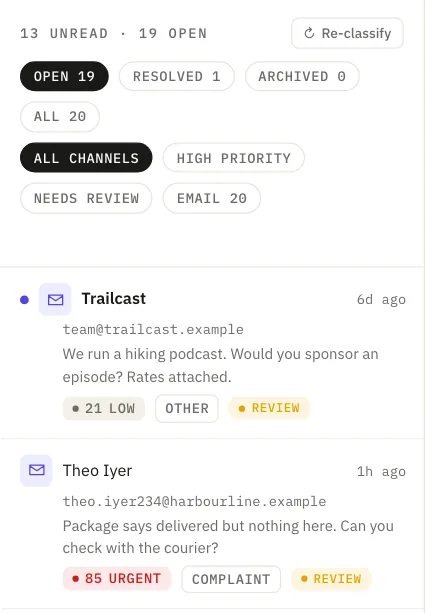
Same inbox, three different situations.
One label can't tell these apart. Six readings can.
“Looks good. What does this cost for a team our size? We're moving off our current tool this quarter.”
“Hi! I loved your site and I'd love to show you how our SEO service can triple your traffic.”
“That's the third charge I didn't authorise. I'm sending this to my lawyer.”
Somebody wrote back. That's the signal every other tool throws away.
It lands in a shared mailbox and dies. So we read it. Every inbound message is read on six independent axes:
Six answers, not one bucket, which is what lets the priority number mean something, and lets an automation trigger on “an angry customer replied about billing” rather than “someone replied”.
Shown, not asserted.
Each reply gets a 0 to 100 priority score built from those six axes plus your existing relationship with the sender, and risk flags for things worth surfacing immediately: a legal threat, a chargeback, something escalating. Open the score and you see which factors contributed what. If you disagree, you can see exactly where to disagree.
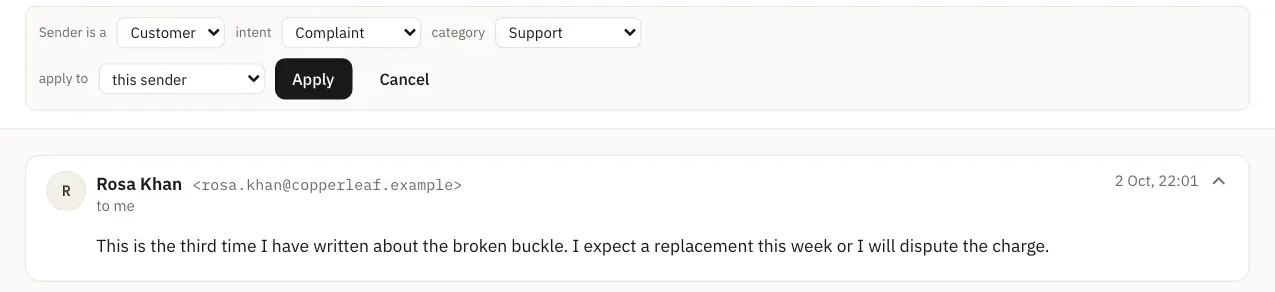
Classification reads the conversation, not just the message.
Have you emailed this person? Are they a known contact? How many exchanges have there been? A stranger enthusiastically selling you SEO services is a vendor, however positive the language, and it won't pollute your lead segments with a tag it didn't earn. Tools that read each message in isolation get this wrong constantly.
It learns your workspace, and only your workspace.
- Fix it once. Disagree with a reading and correct it. That correction becomes a rule for that sender or that domain, applied deterministically to future messages.
- Nothing you correct trains a model shared with anyone else. No cross-customer training, at all.
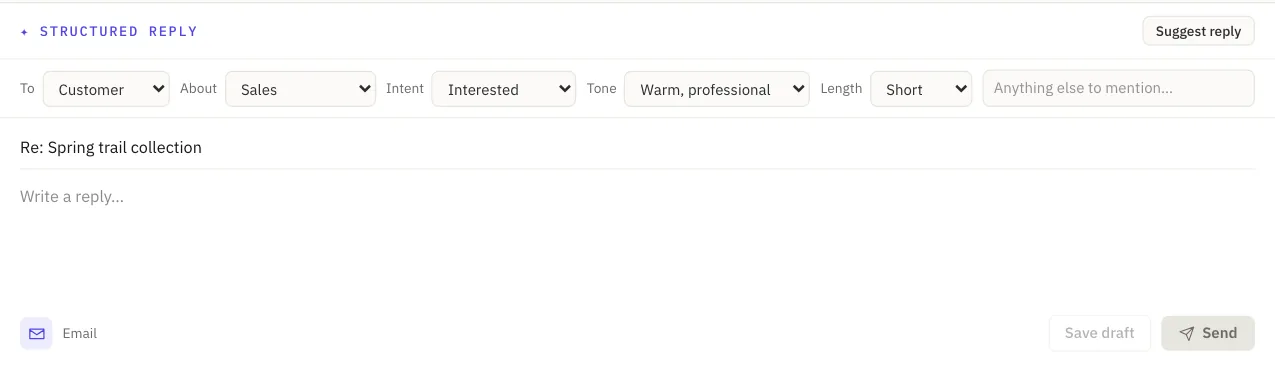
A dropdown, not a prompt box.
Pick the situation and the most specific playbook wins, assembling the draft in your brand's voice. Anything needing a fact it doesn't have is marked for you to fill in rather than invented. Anything flagged for review or carrying a risk flag is draft-only and cannot be auto-sent, however confident the draft looks.
It feeds everything else.
Replies raise engagement scores, trigger automations, update contact health, and appear on the contact's timeline. A weekly digest summarises what came in, with per-person preferences and a one-click opt-out.
Open rate stopped being a measurement. Replies didn't.
Apple Mail preloads images for most of its users, so your open pixel fires whether or not anyone looked. A large share of reported opens are software. We record opens and show them, marked unreliable, and we never let them count toward anything: not a contact's score, not a segment, not an automation branch, not a report's headline.
What we score is a click, a reply, a conversion. Weighted: a conversion outranks a reply, a reply outranks a click, because that's the order of how much intent each one takes. Then decayed by recency, so a contact who was hot in February and silent since doesn't keep looking valuable in August. The curve saturates, so nobody reaches 100 because a link prefetcher fired forty times.
Automation goals work the same way: a conversion, a reply, an engagement tier moving up. Never an open.
The cost of being honest: your reported numbers will be smaller here than in the tool you're leaving. Not because less is happening, but because we stopped counting the machines.
Using a resend to non-openers today? Read why a non-opener list misleads and what to follow up on instead.
Stop losing
the replies that matter.
Every reply read on six axes, ranked by a priority you can question, and answered from a draft you control.